


What sweeter music can we bring,
Than a carol, for to sing
The birth of this our heavenly King?
Awake the voice! Awake the string!
Heart, ear, and eye, and every thing
Awake! the while the active finger
Runs division with the singer.
Dark and dull night, fly hence away,
And give the honour to this day,
That sees December turned to May.
If we may ask the reason, say;
The why, and wherefore all things here
Seem like the springtime of the year?
Why does the chilling winter's morn
Smile, like a field beset with corn?
Or smell, like to a mead new-shorn,
Thus, on the sudden? Come and see
The cause, why things thus fragrant be:
'Tis He is borne, whose quick'ning birth
Gives life and luster, public mirth,
To Heaven, and the under-Earth.
We see Him come, and know him ours,
Who, with His sunshine, and His showers,
Turns all the patient ground to flowers.
The Darling of the world is come,
And fit it is, we find a room
To welcome Him. The nobler part
Of all the house here, is the heart,
Which we will give Him; and bequeath
This holly, and this ivy wreath,
To do Him honour, who's our King,
And Lord of all this revelling.
Showing posts with label Festivity. Show all posts
Showing posts with label Festivity. Show all posts
25 December 2017


26 July 2016
An Evensong for Bach, Handel, and Purcell
The Episcopalian sanctorale, to the extent that it is observed at all, is a higgledy-piggledy affair. But it is gratifying, nonetheless, to note that three very good composers — J.S. Bach, G.F. Handel, and Henry Purcell — have their very own commemoration on July 28th. (That this day happens to coïncide with my birthday is merely gravy.) I am not prepared to argue for any particular sanctity of these three men; indeed, sources suggest their moral failings were as plentiful as anyone's. But theirs is some of the best music the Christian tradition has produced. In thanksgiving for this, and for sacred music in general, we at St. Luke's, Dixon put on a nice little Evensong this past Sunday, the musical selections of which I share here.
Organ voluntary: Dieterich Buxtehude - Praeludium in D Major, BuxWV 139
Hymn 432 "O praise ye the Lord!" Laudate Dominum
Preces (by William Smith)
Psalm 150 (Tone VIII, by Basil Kazan)
Magnificat (by Thomas Tallis, from the Dorian Service)
Nunc dimittis (ibid.)
Responses (by William Smith)
Pater noster (by Robert Stone)
Anthem: Henry Purcell - An Evening Hymn, Z.193
Hymn 24 "The day thou gavest, Lord, is ended" St. Clement
Organ voluntary: Herbert Brewer - Carillon
Organ voluntary: Dieterich Buxtehude - Praeludium in D Major, BuxWV 139
Hymn 432 "O praise ye the Lord!" Laudate Dominum
Preces (by William Smith)
Psalm 150 (Tone VIII, by Basil Kazan)
Magnificat (by Thomas Tallis, from the Dorian Service)
Nunc dimittis (ibid.)
Responses (by William Smith)
Pater noster (by Robert Stone)
Anthem: Henry Purcell - An Evening Hymn, Z.193
Hymn 24 "The day thou gavest, Lord, is ended" St. Clement
Organ voluntary: Herbert Brewer - Carillon
25 March 2014
Lady Day
One benefit of winter's continued presence here, in the desolate heart of this North American continent, is that, now that we've had a week off for Spring Break, one can immediately distinguish between the tanned, crazed, oversexed, overliquored, improvident hedonists (who spent the last week in brighter climes) and the God-fearing, upstanding, abstemious, frugal and very pale Puritans, surely God's Elect (who didn't have the money to traipse off to Texas or Mexico or Florida or a similar place of higher crime rates and insufficient government regulation). I, for one, appreciate the convenience of being able to distinguish between the two at a glance. It certainly saves the time and effort of getting to know people.
The weather makes it difficult to believe that Lady Day is already upon us. (For some reason I am reminded of the O'Hara poem "The Day Lady Died", though that was in July. And Billie Holiday has no connection to the Theotokos, so far as I am aware.) I am continually astonished — indeed, my mouth must be perpetually agape — that the Church does not make terribly much of the Feast of the Annunciation. Why, it seems to me that it should be a bigger celebration than Christmas, don't you think? Babies are born with some regularity; while Jesus's birth was a good thing (I suppose), a birth is a rather ordinary event, in the grand scheme of things. But the very beginning of the Incarnation? Well. It just seems a bit more unusual. The Nicene Creed (or, if we're to be pedantic — and when have we ever turned up the chance to be pedantic? — the Niceno-Constantinopolitan Creed) emphasizes the Incarnation, and indeed, that's the spot in the Creed where one kneels (or, if one is Episcopalian, bows, or looks around confusedly, or does nothing whatsoëver; I believe all options are encouraged in Episcopal rubrics).
For obvious reasons the Annunciation is one of the most popular images in Christian Art. There is an extraordinary variety of very good paintings, woodcuts, windows, sculptures, et alia that depict the moment. I am very fond of Dürer's (as always), and Fra Angelico's, but my current favorite is the version of Henry Ossawa Tanner.
The weather makes it difficult to believe that Lady Day is already upon us. (For some reason I am reminded of the O'Hara poem "The Day Lady Died", though that was in July. And Billie Holiday has no connection to the Theotokos, so far as I am aware.) I am continually astonished — indeed, my mouth must be perpetually agape — that the Church does not make terribly much of the Feast of the Annunciation. Why, it seems to me that it should be a bigger celebration than Christmas, don't you think? Babies are born with some regularity; while Jesus's birth was a good thing (I suppose), a birth is a rather ordinary event, in the grand scheme of things. But the very beginning of the Incarnation? Well. It just seems a bit more unusual. The Nicene Creed (or, if we're to be pedantic — and when have we ever turned up the chance to be pedantic? — the Niceno-Constantinopolitan Creed) emphasizes the Incarnation, and indeed, that's the spot in the Creed where one kneels (or, if one is Episcopalian, bows, or looks around confusedly, or does nothing whatsoëver; I believe all options are encouraged in Episcopal rubrics).
For obvious reasons the Annunciation is one of the most popular images in Christian Art. There is an extraordinary variety of very good paintings, woodcuts, windows, sculptures, et alia that depict the moment. I am very fond of Dürer's (as always), and Fra Angelico's, but my current favorite is the version of Henry Ossawa Tanner.


30 March 2013
There Is but One, and That One Ever
Allow me to present a first in the history of this-a-here web-log: a repost. There is no other Easter poem I like better than George Herbert's "Easter", and Ralph Vaughan Williams's setting of it (from his Five Mystical Songs) is very fine indeed.
EASTER, +George Herbert (1593-1633)
I got me boughs off many a tree:
But thou wast up by break of day,
And brought’st thy sweets along with thee.
The Sunne arising in the East,
Though he give light, & th’ East perfume;
If they should offer to contest
With thy arising, they presume.
Can there be any day but this,
Though many sunnes to shine endeavour?
We count three hundred, but we misse:
There is but one, and that one ever.
EASTER, +George Herbert (1593-1633)
Rise heart; thy Lord is risen.  Sing his praise
                                                  Without delayes,
Who takes thee by the hand, that thou likewise
                                                  With him mayst rise:
That, as his death calcined thee to dust,
His life may make thee gold, and much more, just.

Awake, my lute, and struggle for thy part
                                                  With all thy art.
The crosse taught all wood to resound his name,
                                                  Who bore the same.
His stretched sinews taught all strings, what key
Is best to celebrate this most high day.

Consort both heart and lute, and twist a song
                                                  Pleasant and long:
Or, since all musick is but three parts vied
                                                  And multiplied,
O let thy blessed Spirit bear a part,
And make up our defects with his sweet art.
I got me flowers to strew thy way;
I got me boughs off many a tree:
But thou wast up by break of day,
And brought’st thy sweets along with thee.
The Sunne arising in the East,
Though he give light, & th’ East perfume;
If they should offer to contest
With thy arising, they presume.
Can there be any day but this,
Though many sunnes to shine endeavour?
We count three hundred, but we misse:
There is but one, and that one ever.
10 February 2013
Transfiguration, Observed?
This evening St. Luke's observed the Feast of the Transfiguration with a chant evensong. I am pleased to report that it went well. (And anyway, I appreciate any excuse to use incense and vest properly for evensong — it is one of the few occasions when I am permitted to wear my academic hood over my cassock and surplice.) I adapted the order of worship myself, drawing on both the vespers office from the Liber — which has a lovely series of antiphons drawn from Matthew's account of the Transfiguration — and the BCP (Rite I, of course).
There are, however, several questions about the observance of this particular feast. The Transfiguration was observed in the East by the 4th or 5th century, but is not mentioned in Western sources until around 850. As, of course, different dioceses had their particular calendars, the date of the feast was not consistent. Many observed it on August 6th, but it was also celebrated on July 27th (England and Gaul), March 17th (Meissen), and September 3rd (Halberstadt), among other dates. The feast was not universally authorized until 1456, when Callixtus III instituted it in commemoration of the defeat of the Turks at Belgrade. The date of the feast was established then as August 6th, the day the news of the Christian victory reached Rome. But the siege of Belgrade was lifted on July 22nd, which is of course the feast of Mary Magdalene. And why, one wonders, did Rome not already observe August 6th as the feast of St. Dominic, who died on that date in 1221 (and was canonized only thirteen years later)? There is no satisfying answer. Many early Reformers, being by nature a suspicious breed, viewed the feast as a too-recent innovation, and removed it from the calendar. (It has gradually crept back in.) Add to this confusion the modern custom of observing the Transfiguration on the last Sunday before Lent (the Sunday formerly known as Quinquagesima), for reasons that are not entirely clear. The Revised Common Lectionary has transfiguration readings for that Sunday every year in the three-year cycle, while the current BCP has transfiguration readings for that Sunday in Years B and C. (It was thus fortuitous for our purposes at St. Luke's that this is Year C.) The Romans have placed transfiguration readings on the second Sunday of Lent, but are, apparently, still keeping the feast on its (somewhat) original August date. Those Lutherans lucky enough to be using the historic one-year lectionary — oh, to be able to hear Bach's cantatas in their proper context! — observe the Transfiguration during the Epiphany season, on the Sunday before Septuagesima. (This year, for example, the feast was January 20th.)
All of this confusion probably stems, in part, from the difficulty in placing the Transfiguration in context in the life and ministry of Jesus. Just what, exactly, does this particular miracle mean? Is it the culmination of his early years, or just another event in his ministry? And, what's more, should that matter? To what extent should the liturgical year mirror the life of Christ? I would suggest that attempts to change the calendar to fit the order of events in the Gospels (like the moving of the regrettably under-observed Feast of the Visitation) are not particularly helpful. But then, I am terribly conservative, if not reäctionary, in my liturgical tastes.
For some more information (and a kindred spirit in matters liturgical), I'll refer you to Fr A, who muses on the (neat) custom of blessing grapes at Transfiguration and addresses the awkwardness of a second feast.
There are, however, several questions about the observance of this particular feast. The Transfiguration was observed in the East by the 4th or 5th century, but is not mentioned in Western sources until around 850. As, of course, different dioceses had their particular calendars, the date of the feast was not consistent. Many observed it on August 6th, but it was also celebrated on July 27th (England and Gaul), March 17th (Meissen), and September 3rd (Halberstadt), among other dates. The feast was not universally authorized until 1456, when Callixtus III instituted it in commemoration of the defeat of the Turks at Belgrade. The date of the feast was established then as August 6th, the day the news of the Christian victory reached Rome. But the siege of Belgrade was lifted on July 22nd, which is of course the feast of Mary Magdalene. And why, one wonders, did Rome not already observe August 6th as the feast of St. Dominic, who died on that date in 1221 (and was canonized only thirteen years later)? There is no satisfying answer. Many early Reformers, being by nature a suspicious breed, viewed the feast as a too-recent innovation, and removed it from the calendar. (It has gradually crept back in.) Add to this confusion the modern custom of observing the Transfiguration on the last Sunday before Lent (the Sunday formerly known as Quinquagesima), for reasons that are not entirely clear. The Revised Common Lectionary has transfiguration readings for that Sunday every year in the three-year cycle, while the current BCP has transfiguration readings for that Sunday in Years B and C. (It was thus fortuitous for our purposes at St. Luke's that this is Year C.) The Romans have placed transfiguration readings on the second Sunday of Lent, but are, apparently, still keeping the feast on its (somewhat) original August date. Those Lutherans lucky enough to be using the historic one-year lectionary — oh, to be able to hear Bach's cantatas in their proper context! — observe the Transfiguration during the Epiphany season, on the Sunday before Septuagesima. (This year, for example, the feast was January 20th.)
All of this confusion probably stems, in part, from the difficulty in placing the Transfiguration in context in the life and ministry of Jesus. Just what, exactly, does this particular miracle mean? Is it the culmination of his early years, or just another event in his ministry? And, what's more, should that matter? To what extent should the liturgical year mirror the life of Christ? I would suggest that attempts to change the calendar to fit the order of events in the Gospels (like the moving of the regrettably under-observed Feast of the Visitation) are not particularly helpful. But then, I am terribly conservative, if not reäctionary, in my liturgical tastes.
For some more information (and a kindred spirit in matters liturgical), I'll refer you to Fr A, who muses on the (neat) custom of blessing grapes at Transfiguration and addresses the awkwardness of a second feast.
26 December 2012
St. Stephen's Day
Per multas tribulationes oportet nos intrare in regnum Dei.
Actus Apostolorum 14:21
The life of a church musician being unmitigated misery and self-loathing in the days leading up to Christmas, it really is quite a relief when the last note of music ceases to resound after the last Mass of Christmas Day. (Honesty compels me to admit that I exaggerate, slightly. But this year I anticipated Christmas Eve as the sinner anticipates the Day of Judgement: waiting to be consigned to the eternal fire, to eat nought but burning-hot coals and drink nought but burning-hot cola. I must somehow learn not to worry on behalf of other musicians, or I shall have to find some other vocation.)
Ah, but now, now it is Christmas, at least until Twelfth Night. (I have plans for Epiphany, as the Bishop is visiting, but preparing solo organ music inspires me with comparatively little dread.) And today is Boxing Day, or the Feast of St. Stephen the Protomartyr, if you prefer. Diplomacy was not Stephen's forte, to be certain. It takes a certain foolhardiness, or perhaps blissful unawareness, to, when facing a crowd quite ready to stone you, address them thusly:
Ye stiffnecked and uncircumcised in heart and ears, ye do always resist the Holy Ghost: as your fathers did, so do ye. Which of the prophets have not your fathers persecuted? and they have slain them which shewed before of the coming of the Just One; of whom ye have been now the betrayers and murderers: who have received the law by the disposition of angels, and have not kept it.It is curious that Christians should so honor a man who pretty clearly brought his martyrdom upon himself. There must be a line, somewhere, between willingness to profess one's faith and eagerness for martyrdom. Perhaps that is the same line I must learn to draw between doing one's job and suffering for one's job. Hmm.
In any case, permit me to wish you, dear reader, "a wonderful Christmastime" (as Paul McCartney so catchily and irritatingly put it).
08 April 2012
Surrexit Christus

The Bible characters I most relate to are those who have no idea what's going on, those who are more or less ignorant of their place in the narrative of salvation. Perhaps for this reason I prefer the three women — who go to the tomb early Sunday morning — as they are described in the reading from Mark: "they went out quickly, and fled from the sepulchre; for they trembled and were amazed: neither said they any thing to any man; for they were afraid." People, with the exception of certain saints and poets, are generally not very good at recognizing the work of God: we are more likely to be doubtful, or confused, or "affrighted" (as the Authorised Version puts it), than to observe God's workings with serenity and joy. We do, if we are fortunate, have moments in which the utter mystery of God is somehow tolerable. Well, "tolerable" is not really the word I mean. I don't mean we merely tolerate God; I mean that there are moments in which Grace — which by its nature is uncomfortable for us — is not only less uncomfortable but actually comforting. I hope, dear reader, if you celebrate Easter, that you may have such a moment during this season.
25 December 2011
In dulci jubilo
In dulci jubilo,
Nun singet und seid froh!
Unsers Herzens Wonne liegt
in praesepio,
Und leuchtet als die Sonne
Matris in gremio,
Alpha es et O!
O Jesu parvule
Nach dir ist mir so weh!
Tröst' mir mein Gemüte
O puer optime
Durch alle deine Güte
O princeps gloriae.
Trahe me post te!
O Patris caritas!
O Nati lenitas!
Wir wären all verdorben
Per nostra crimina
So hat er uns erworben
Coelorum gaudia
Eia, wären wir da!
Ubi sunt gaudia
Nirgend mehr denn da!
Da die Engel singen
Nova cantica,
Und die Schellen klingen
In regis curia.
Eia, wären wir da!
24 December 2011
"The Blessed Son of God"

Being the fifth movement from his Christmas cantata Hodie
Performed by The Tudor Choir on this CD.
Or, if you are averse to downloading, listen to a fine performance here.
The blessed Sonne of God onely— Myles Coverdale, after Martin Luther (a loose translation of selected verses of "Gelobet seist du, Jesu Christ")
In a crybbe full poore dyd lye:
With oure poore flesh and oure poore bloude
Was clothed that everlastynge good.
Kirieleyson.
The Lorde Christ Jesu, God’s Sonne deare,
Was a gest and a straunger here;
Us for to brynge from mysery,
That we might lyve eternally.
Kirieleyson.
All this dyd He for us frely,
For to declare His great mercy:
All Christendome be mery therfore,
And geve Hym thankes evermore.
Kirieleyson.
13 December 2011
St. Lucy's Day
The best method of getting into the mind of prehistoric man is to spend more time outdoors. Perhaps the first thing one notices, upon doing so, is that one becomes far more aware of natural cycles: the phase of the moon, the barometric pressure, the time the sun sets (or, if you are un buen madrugador, the time it rises). Around this time of year it is quite possible to believe that the days will continue to get shorter and shorter until some scientist finally notices that the Earth's axis has somehow started tipping and our hemisphere will never see light again. This is, of course, implausible, though stranger things have happened elsewhere in the galaxy. The worst-case scenario would be a tidally-locked planet, with constant light in one hemisphere and constant darkness in t'other. Another possibility is a fate like that of the planet Uranus, the axis of which is so tilted that each pole is in complete darkness for forty-two years; of course, its orbital period is also much longer than Earth's. Whatever our axial tilt is, for those of us sensitive to a lack of sunlight the solstice can't come too soon.
 Coïncidentally or not, today is the feast of Saint Lucy, long thought to be the shortest day of the year. ("'Tis the year's midnight", as Donne says.) The saint's connection with light needs little explanation.
There are, as it happens, quite a few hymns appropriate for this time of year. Many are used at compline. Perhaps the best is Christe, qui lux es et dies. (If you ever get a chance to hear Robert White's four polyphonic settings, do so. Here are the first and last; I can't readily find the other two.) This hymn was, in turn, adapted into two German chorales: Christe, der du bist Tag und Licht and Christe, der du bist der helle Tag. Another compline hymn is Te lucis ante terminum; my favorite version is the mode VIII melody used on ordinary Sundays and minor feasts. Other hymns include Conditor alme siderum and Lucis creator optime.
Some might complain that we've become too accustomed to the dichotomy between light and darkness, with its implication that light is to be preferred. This does not bother me. As anyone who has woken before the dawn can tell you, it is natural for man to want light. Consider Psalm 130:
 Coïncidentally or not, today is the feast of Saint Lucy, long thought to be the shortest day of the year. ("'Tis the year's midnight", as Donne says.) The saint's connection with light needs little explanation.
There are, as it happens, quite a few hymns appropriate for this time of year. Many are used at compline. Perhaps the best is Christe, qui lux es et dies. (If you ever get a chance to hear Robert White's four polyphonic settings, do so. Here are the first and last; I can't readily find the other two.) This hymn was, in turn, adapted into two German chorales: Christe, der du bist Tag und Licht and Christe, der du bist der helle Tag. Another compline hymn is Te lucis ante terminum; my favorite version is the mode VIII melody used on ordinary Sundays and minor feasts. Other hymns include Conditor alme siderum and Lucis creator optime.
Some might complain that we've become too accustomed to the dichotomy between light and darkness, with its implication that light is to be preferred. This does not bother me. As anyone who has woken before the dawn can tell you, it is natural for man to want light. Consider Psalm 130:
I wait for the LORD, my soul doth wait, and in his word do I hope.
My soul waiteth for the Lord more than they that watch for the morning: I say, more than they that watch for the morning.
14 August 2011
St. Mary the Virgin (Observed)
Today the Episcopalians of Dixon, Illinois — whose organist I now, er, am — celebrated the feast day of St. Mary the Virgin. We did some fine hymns (including that versification of the Magnificat, set to "Woodlands", which is an eminently singable tune), and the assigned readings are also very good. Father's sermon addressed the place of Mary in the Christian tradition; in true High-Church Anglican fashion, he said enough things to alienate both Roman Catholics and Protestants. But I happen to think that in this issue — as in many others — the via media is the via optima. Taking into account Mary's special place in God's redemption narrative, one may reasonably consider her the greatest of the saints. Some Lutherans, and most other Protestants, forget this. (Recall, though, that there have always been Lutherans who have relied on the intercession of saints, with the proper understanding that God alone is the source of all grace.) But, on the other hand, not even the Theotokos is worthy of worship. Miffed Roman Catholics will insist that they do not worship but rather venerate her (a fine distinction, to be sure), but certain Romish ideas — such as the understanding of Mary as Co-Redemptrix — seem to me quite certainly idolatrous.
But enough of argumentative things. I'll refer you to the post I wrote at Annunciation, with a Pärt setting of the Magnificat and excerpts from a rather good sermon. And here is Mary's song (Luke 1:46-55), for your dose of sweet sweet Book of Common Prayer:
But enough of argumentative things. I'll refer you to the post I wrote at Annunciation, with a Pärt setting of the Magnificat and excerpts from a rather good sermon. And here is Mary's song (Luke 1:46-55), for your dose of sweet sweet Book of Common Prayer:
My soul doth magnify the Lord, and my spirit hath rejoiced in God my Saviour.
For he hath regarded the lowliness of his handmaiden.
For behold, from henceforth all generations shall call me blessed.
For he that is mighty hath magnified me, and holy is his Name.
And his mercy is on them that fear him, throughout all generations.
He hath shewed strength with his arm; he hath scattered the proud in the imagination of their hearts.
He hath put down the mighty from their seat, and hath exalted the humble and meek.
He hath filled the hungry with good things, and the rich he hath sent empty away.
He remembering his mercy hath holpen his servant Israel, as he promised to our forefathers, Abraham and his seed, for ever.
24 April 2011
Christ ist erstanden
 "The Resurrection", from Matthias Grünewald's stunning Isenheim Altarpiece. This is the primary reason I want to visit Alsace.
Lutheran Worship, the old blue hymnal we used to use, had its flaws — and they were numerous — but one thing I liked very much about it was its pairing of two particular Easter hymns, Christ lag in Todesbanden (#123) and Christ ist erstanden (#124), on facing pages: it's a grand thing to go from one great melody to another. (They're both based on everyone's favorite sequence, Victimae paschali laudes, anyway.) For your paschal edification, here are settings of each hymn:
J.S. Bach: Christ lag in Todesbanden, chorale, the second movement of BWV 4.
Michael Praetorius: Christ ist erstanden, from Polyhymnia Caduceatrix et Panegyrica (1619).
25 March 2011
Annunciation
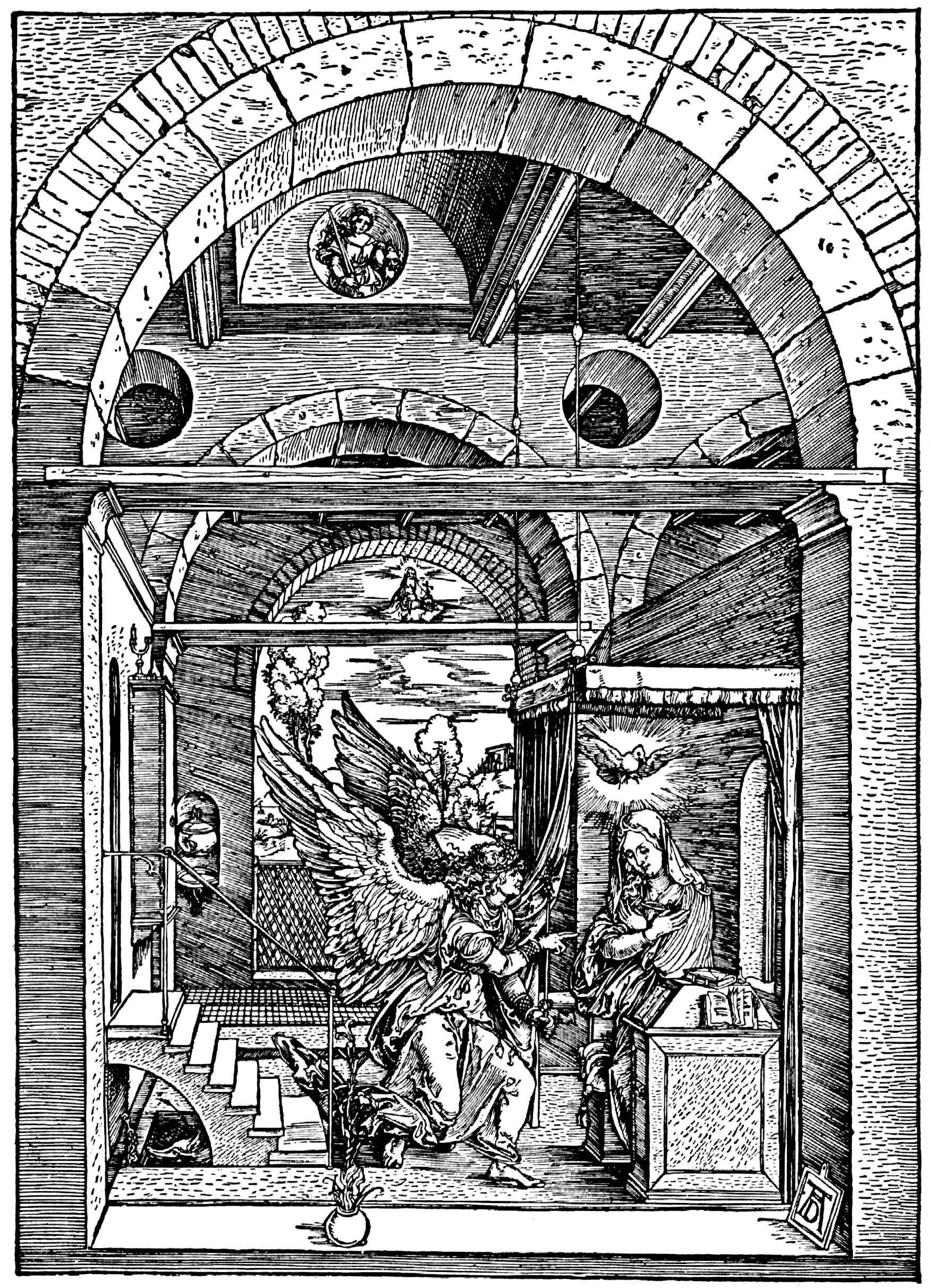
Today is the Feast of the Annunciation. For my part, I will be playing for a service with the (precipitously high-church, Deo gratias) Lutherans over at Emmaus.
Shortly after the account of the Annunciation (Luke 1:26-38) comes the greatest of the Biblical canticles, the Magnificat. For your edification, I offer an excellent recording of Arvo Pärt's setting of this song, as well as two excerpts of a sermon Luther gave on the Magnificat.
(Performed by the Estonian Philharmonic Chamber Choir, dir. Tõnu Kaljuste, found on this CD.)
Luke 1:46-47 (Authorised Version): And Mary said, "My soul doth magnify the Lord, and my spirit hath rejoiced in God my Saviour."
For God is not magnified by us so far as His nature is concerned — He is unchangeable — but He is magnified in our knowledge and experience, when we greatly esteem Him and highly regard Him, especially as to his grace and goodness. Therefore the holy Mother does not say, “My voice or my mouth, my hand or my thoughts, my reason or my will, doth magnify the Lord.” For there be many who praise God with a loud voice, preach about Him with high sounding words, speak much of Him, dispute and write about Him and paint His image; whose thoughts dwell often upon Him, and who reach out after Him and speculate about Him with their reason; there are also many who exalt Him with false devotion and a false will. But Mary says, “My soul doth magnify Him” — that is, my whole life and being, mind and strength, esteem Him highly.
Luke 1:48-49: "For he hath regarded the low estate of his handmaiden: for, behold, from henceforth all generations shall call me blessed. For he that is mighty hath done to me great things; and holy is his name."
The "great things" are nothing less than that she became the Mother of God, in which work so many and such great good things are bestowed upon her as pass man's understanding. For on this there follows all honor, all blessedness, and her unique place in the whole of mankind, among whom she has no equal, namely, that she had a child by the Father in Heaven, and such a child. She herself is unable to find a name for this work, it is too exceedingly great; all she can do is break out in the fervent cry: "They are great things", impossible to describe or define. Hence men have crowded all her glory into a single word, calling her the Mother of God. No one can say anything greater of her or to her, though he had as many tongues as there are leaves on the trees, or grass in the fields, or stars in the sky, or sand by the sea. It needs to be pondered in the heart, what it means to be the Mother of God.
09 March 2011
Ash Wednesday
Both the Old Testament and Epistle readings for today (in the Papist lectionary, anyway) emphasize that now is actually a pretty good time to start being good. Joel 2:12-13, in Coverdale's translation, reads:
(Who says centuries-old translations aren't acceptable? With the possible exceptions of "rend" and "long-suffering", I daresay the passage is perfectly understandable, even to the average American. Bible translations that dumb-down the language — viz., the NIV, the NAB, et alia, ad nauseam — are only greasing the slippery slope towards illiteracy.) Consider also part of today's Epistle, from 2 Corinthians 6:1-2:
(Again, no problems with the language except perhaps "exhort" and "succored", but certainly every college graduate should know these words.)
To these exhortations let us add that of John Donne. They don't make many Anglicans like John Donne anymore; this is a pity. In a sermon preached to Queen Anne (James I's consort, not the later queen regnant), he echoes a passage from Augustine's Confessions:
12Now therfore saieth the LORDE: Turne you vnto me with all youre hertes, with fastinge, wepynge and mournynge: 13rente youre hertes, & not youre clothes. Turne you vnto the LORDE youre God, for he is gracious & mercifull, longe sufferynge & of greate compassion: & redy to pardone wickednes.
(Who says centuries-old translations aren't acceptable? With the possible exceptions of "rend" and "long-suffering", I daresay the passage is perfectly understandable, even to the average American. Bible translations that dumb-down the language — viz., the NIV, the NAB, et alia, ad nauseam — are only greasing the slippery slope towards illiteracy.) Consider also part of today's Epistle, from 2 Corinthians 6:1-2:
1We as helpers therfore exhorte you, that ye receaue not ye grace of God in vayne. 2For he sayeth: I haue herde the in the tyme accepted, and in the daye of saluacion haue I succoured the. Beholde, now is the accepted tyme, now is the daye of saluacion.
(Again, no problems with the language except perhaps "exhort" and "succored", but certainly every college graduate should know these words.)
To these exhortations let us add that of John Donne. They don't make many Anglicans like John Donne anymore; this is a pity. In a sermon preached to Queen Anne (James I's consort, not the later queen regnant), he echoes a passage from Augustine's Confessions:
Yet if we have omitted our first early, our youth, there is one early left for us; this minute; seek Christ early, now, now, as soon as his Spirit begins to shine upon your hearts. Now as soon as you begin your day of Regeneration, seek him the first minute of this day, for you know not whether this day shall have two minutes or no, that is, whether his Spirit, that descends upon you now, will tarry and rest upon you or not, as it did upon Christ at his baptisme.
Therefore shall every one that is godlie make his Prayer unto thee O God, in a time when thou may'st be found: we acknowledg this to be that time, and we come to thee now early, with the confession of thy servant Augustine, sero te amavi pulchritudo tam antiqua, tam nova; O glorious beauty, infinitely reverend, infinitely fresh and young, we come late to thy love, if we consider the past daies of our lives, but early if thou beest pleased to reckon with us from this houre of the shining of thy grace upon us; and therefore O God, as thou hast brought us safely to the beginning of this day, as thou hast not given us over to a finall perishing in the works of night and darkness, as thou hast brought us to the beginning of this day of grace, so defend us in the same with thy mighty power, and grant that this day, this day of thy visitation, we fall into no sin, neither run into any kind of danger, no such sinne, no such danger as may separate us from thee, or frustrate us of our hopes in that eternall kingdom which thy Sonne our saviour Christ Jesus hath purchased for us with the inestimable price of his incorruptible blood.
25 December 2010
Puer natus est nobis
It has been my experience that every Christmas season is more miserable than the previous one. This impression may indeed be borne out by objective facts: each year the world is generally a worse place. The great mass of people are more acquisitive, not less; they are more ignorant, not less. I find television more and more insufferable each year. (A notable exception to this was the airing of the Chuck Jones version of How the Grinch Stole Christmas! that I caught the other day. It still holds up. The irony, of course, is that a story about Christmas being worth more than mere presents is punctuated by commercials exhorting us to spend more than we can afford for things we do not need.)
Oh, but let us set aside such complaints. The Feast of the Incarnation is as good an occasion as any to be joyful. I find that I am at least happy when working — that is, when playing the organ. The Lutherans last night sang lustily, and the instrument was a fine Casavant (out-of-tune krummhorn notwithstanding). Why, some brave members of the congregation even attempted the high descant at the end of "The First Nowell". The important thing about congregational singing is not that it be particularly beautiful to listen to, but that it be enthusiastic and sincere. These Lutherans passed the test.
For the season, I offer a brief (minute-long) setting of what is perhaps my favorite carol, performed by The King's Singers:
J.S. Bach: In dulci jubilo
Oh, but let us set aside such complaints. The Feast of the Incarnation is as good an occasion as any to be joyful. I find that I am at least happy when working — that is, when playing the organ. The Lutherans last night sang lustily, and the instrument was a fine Casavant (out-of-tune krummhorn notwithstanding). Why, some brave members of the congregation even attempted the high descant at the end of "The First Nowell". The important thing about congregational singing is not that it be particularly beautiful to listen to, but that it be enthusiastic and sincere. These Lutherans passed the test.
For the season, I offer a brief (minute-long) setting of what is perhaps my favorite carol, performed by The King's Singers:
12 December 2010
Gaudete Sunday

To my list of many weaknesses we may add "middle-aged ladies giving out free samples at grocery stores". I am entirely unable to refuse a kindly-offered free sample, even if I am quite sure I don't want it. I then feel obligated to buy whatever the product is. Today I purchased some peanut brittle. I don't really care for peanut brittle, but being unable to resist this particular sort of sales pitch, here we are: now I have a package of peanut brittle. I suppose the best thing to do now is to bring it to this evening's annual Basilica Schola Gaudete Sunday party. (Yes, it is already Gaudete Sunday! Did you wear pink today? I could not summon the courage to buy a pink shirt, but I got a pink tie on sale.)
04 October 2010
St. Francis
Today is the feast of St. Francis of Assisi. By a happy coïncidence, it also happened that today there was a lecture given here at Notre Dame on G.K. Chesterton, which I attended. Here's a bit of what Chesterton has to say about Francis:
I'll refer you also to Chesterton's biography of St. Francis.
The current Pope, when he was still Cardinal Ratzinger, noted that "[t]he only really effective apologia for Christianity comes down to two arguments, namely, the saints the Church has produced, and the art which has grown in her womb." St. Francis is one of those saints who represent Christianity rather well, if I do say so myself. Incidentally, I don't doubt that the Christian religion is still producing saints, though few of them have such good P.R. as Mother Teresa. The real question is whether there is any more Christian art being produced nowadays. (Let's save that topic for another day, shall we?)
To most people ... there is a fascinating inconsistency in the position of Saint Francis. He expressed in loftier and bolder language than any earthly thinker the conception that laughter is as divine as tears. He called his monks the mountebanks of God. He never forgot to take pleasure in a bird as it flashed past him, or a drop of water as it fell from his finger: he was, perhaps, the happiest of the sons of men. Yet this man undoubtedly founded his whole polity on the negation of what we think the most imperious necessities; in his three vows of poverty, chastity, and obedience, he denied to himself and those he loved most, property, love, and liberty. Why was it that the most large-hearted and poetic spirits in that age found their most congenial atmosphere in these awful renunciations? Why did he who loved where all men were blind, seek to blind himself where all men loved? Why was he a monk and not a troubadour? These questions are far too large to be answered fully here, but in any life of Francis they ought at least to have been asked; we have a suspicion that if they were answered we should suddenly find that much of the enigma of this sullen time of ours was answered also.
I'll refer you also to Chesterton's biography of St. Francis.
The current Pope, when he was still Cardinal Ratzinger, noted that "[t]he only really effective apologia for Christianity comes down to two arguments, namely, the saints the Church has produced, and the art which has grown in her womb." St. Francis is one of those saints who represent Christianity rather well, if I do say so myself. Incidentally, I don't doubt that the Christian religion is still producing saints, though few of them have such good P.R. as Mother Teresa. The real question is whether there is any more Christian art being produced nowadays. (Let's save that topic for another day, shall we?)
06 June 2010
Corpus Christi (Observed)
Today is the celebration of the Body of Christ. (Or rather, Thursday was the celebration of the Body of Christ, but it's more convenient to do the celebrating today.) The term has two senses, both of which are absurd. The first is that from the Gospel, where Jesus institutes Holy Communion with a piece of bread and the words "this is my body". I'll let Miss O'Connor speak for that:
The second sense is from Paul's letters: here it is the mystical union of all believers under the headship of Christ. Like Christ's earthly body, it is broken and wounded: it gives every impression of being done for. Christians have failed, and continue to fail, at that whole "unity" business, just as we have failed at that "charity" thing. I'm not exactly sure how we're supposed to remedy our shortcomings in embodying the second meaning of "Body of Christ". Perhaps it has something to do with the first meaning.
"Well, toward morning the conversation turned on the Eucharist, which I, being the Catholic, was obviously supposed to defend. [Mary McCarthy] said when she was a child and received the Host, she thought of it as the Holy Ghost, He being the 'most portable' person of the Trinity; now she thought of it as a symbol and implied that it was a pretty good one. I then said, in a very shaky voice, 'Well, if it's a symbol, to hell with it.' That was all the defense I was capable of but I realize now that this is all I will ever be able to say about it, outside of a story, except that it is the center of existence for me; all the rest of life is expendable."
The second sense is from Paul's letters: here it is the mystical union of all believers under the headship of Christ. Like Christ's earthly body, it is broken and wounded: it gives every impression of being done for. Christians have failed, and continue to fail, at that whole "unity" business, just as we have failed at that "charity" thing. I'm not exactly sure how we're supposed to remedy our shortcomings in embodying the second meaning of "Body of Christ". Perhaps it has something to do with the first meaning.

04 April 2010
Easter, George Herbert
Rise heart; thy Lord is risen.  Sing his praise
                                                  Without delayes,
Who takes thee by the hand, that thou likewise
                                                  With him mayst rise:
That, as his death calcined thee to dust,
His life may make thee gold, and much more, just.

Awake, my lute, and struggle for thy part
                                                  With all thy art.
The crosse taught all wood to resound his name,
                                                  Who bore the same.
His stretched sinews taught all strings, what key
Is best to celebrate this most high day.

Consort both heart and lute, and twist a song
                                                  Pleasant and long:
Or, since all musick is but three parts vied
                                                  And multiplied,
O let thy blessed Spirit bear a part,
And make up our defects with his sweet art.
I got me flowers to strew thy way;
I got me boughs off many a tree:
But thou wast up by break of day,
And brought’st thy sweets along with thee.
The Sunne arising in the East,
Though he give light, & th’ East perfume;
If they should offer to contest
With thy arising, they presume.
Can there be any day but this,
Though many sunnes to shine endeavour?
We count three hundred, but we misse:
There is but one, and that one ever.
02 April 2010
Quid est Veritas?
Of all the actors in the Good Friday story, I've always felt a certain kinship with Pilate. (And this is not—only—because I've been playing a lot of Caesar II, which, incidentally, is quite a solid game.) Alone among the characters in the Passion narrative, it is Pilate who most closely approximates the modern man. He is a reluctant bureaucrat, loath to involve himself in some petty squabble of the Jews he was sent by Rome to rule. It is only when the crowds question his loyalty to Caesar that he finally relents and allows Christ to be crucified. Religiously speaking, Pilate has no horse in this race; at least, he's not aware of one. He questions the Nazarene about his purported kingship, and hears his reply:
Pilate is a compelling character not because he is a particularly good or wicked man—though I like to think of him as a secular but virtuous type, like Marcus Aurelius—but because he is the closest thing to a dispassionate spectator in the whole saga. Christ, the "bleeding stinking mad shadow of Jesus", then as now, inspires great love, or great revulsion, but Pilate is unmoved.
37You say that I am a king. For this I was born, and for this I came into the world, to testify to the truth. Everyone who belongs to the truth listens to my voice.But Pilate, the Modern, will have none of it: "what is truth?", he asks. What, indeed, can this provincial Jew, some carpenter's son, have to offer a man whose vision of the world has no absolutes, save self-interest?
Pilate is a compelling character not because he is a particularly good or wicked man—though I like to think of him as a secular but virtuous type, like Marcus Aurelius—but because he is the closest thing to a dispassionate spectator in the whole saga. Christ, the "bleeding stinking mad shadow of Jesus", then as now, inspires great love, or great revulsion, but Pilate is unmoved.
Subscribe to:
Posts (Atom)