


Nothing is so beautiful as Spring —
When weeds in wheels, shoot long and lovely and lush;
Thrush's eggs look little low heavens, and thrush
Through the echoing timber does so rinse and wring
The ear, it strikes like lightnings to hear him sing;
The glassy peartree leaves and blooms, they brush
The descending blue; that blue is all in a rush
With richness; the racing lambs too have fair their fling.
What is all this juice and all this joy?
A strain of the earth's sweet being in the beginning
In Eden garden. — Have, get, before it cloy,
Before it cloud, Christ, lord and sour with sinning,
Innocent mind and Mayday in girl and boy,
Most, O maid's child, thy choice and worthy the winning.
02 May 2011


24 April 2011
Christ ist erstanden
 "The Resurrection", from Matthias Grünewald's stunning Isenheim Altarpiece. This is the primary reason I want to visit Alsace.
Lutheran Worship, the old blue hymnal we used to use, had its flaws — and they were numerous — but one thing I liked very much about it was its pairing of two particular Easter hymns, Christ lag in Todesbanden (#123) and Christ ist erstanden (#124), on facing pages: it's a grand thing to go from one great melody to another. (They're both based on everyone's favorite sequence, Victimae paschali laudes, anyway.) For your paschal edification, here are settings of each hymn:
J.S. Bach: Christ lag in Todesbanden, chorale, the second movement of BWV 4.
Michael Praetorius: Christ ist erstanden, from Polyhymnia Caduceatrix et Panegyrica (1619).
20 April 2011
Media vita in morte sumus
In the midst of life we are in death:
of whom may we seek for succour, but of thee, O Lord?
Recently I've been looking into Tudor church music, especially the sort written during the reign of Mary I. (Foxe's Book of Martyrs notes that "Mary, having succeeded by false promises in obtaining the crown, speedily commenced the execution of her avowed intention of extirpating and burning every Protestant." So you see, children, propaganda is not so modern an invention as we sometimes think.)
The casual listener of classical music may know the name Thomas Tallis, but it is far less likely he knows that of John Sheppard (c.1515-1558), who also wrote music at about the same time. (Oh, the vicissitudes of musical popularity!) Sheppard's work is every bit as impressive as that of his better-known contemporary. Chief among his compositions is a remarkable six-voice setting of the text Media vita, the antiphon for the Nunc Dimittis at Compline on major feast days in the two weeks before Passion Sunday. Though in the one surviving source for this motet (Oxford: Christ Church Library, Mus. 979-983) the tenor partbook is missing, there are several reconstructions, including one by the Tallis Scholars.
performed by the Tallis Scholars (dir. Peter Phillips), available here
The word "poignant", like the word "unique", is terribly overused these days, but I daresay that this motet is poignant; in any case it is well-suited for Lent. It may not even be hyperbole to say that Sheppard's Media vita is one of the most important works of English polyphony.
15 April 2011
Music Links Round-up
- Click the squares: Wondering why there are no dissonances? 'Cause it's a pentatonic scale!
- Nokia fugue: Not bad fugal writing, really. The motivic derivations are not quite as tight as Bach (cf. BWV 547), but there are nice little surprises. (Look for the inversion, for example.)
- Compleat organ works of Bach, available for free download
- Arvo Pärt Information Archive
- Bizarre Musical Deaths
- Our Polyphony Class Web-site: with recordings of Renaissance polyphony by our professor's (pretty good) ensemble, Pomerium
And, for good measure, some web-logs concerning matters musical:
Chantblog
Magister Perotinus
Pipe Organs (dormant, but its archives are worth giving a look-see)
10 April 2011
Humor and Religion
It has been a general guideline of mine, for years, now, not to trust anyone without a sense of humor. Humor is a good and worthwhile thing, and I will have no truck with anyone who insists on doing without it. (Perhaps there are some people who never acquired a proper sense of humor; if so, these are wretches to be pitied. What I am chiefly concerned with, here, is the sort of person who has a sense of humor and seeks to stifle it.) The particular misconception of the humorless is that lightheartedness somehow contradicts the effort to take things seriously, that humor is somehow the opposite of earnestness.
I am sorry to say that there are a great many religious people who feel (and act) this way. Many of them are convinced that religion is A Very Serious Thing Indeed, and that any attempt to acknowledge the inherent humor of certain things (dropped thuribles, outlandish lectors, ridiculous vestments) would be to detract from the dignity and reverence and decorum due to the Mass.
(An aside: it's always about the dignity and reverence and decorum of the Mass, in some Roman Catholic circles. What is dignity and reverence and decorum, anyway? Is it a Mass where nobody smiles, or acknowledges the presence of others? Is proper reverence so easily confused with catatonic rigidity? Mind you, I shudder as much as the next person at the thought of those horror stories of post-Vatican II liturgies — beach balls at Mass, rainbow vestments — but one can acknowledge the human dimension of the liturgy without resorting to such excesses. In any case, it might be worth pointing out that regrettably varicolored vestments are not the sole province of hippies and Franciscans.)
But where was I? Oh, yes, humor. Would you believe, like St. John Chrysostom — or Jorge the monk in Eco's The Name of the Rose — that Christ never laughed? I certainly hope not; there's enough to be construed as humor in the Gospels to suggest that he did. (Roman Catholics may take particular satisfaction in that the Church was founded on a pun.)
In any case, if you would associate with religious types at all, I would suggest the sort with a sense of humor: most Anglicans, for example. Avoid the dire sort of fundamentalists (of both Protestant and Papist persuasions). As for me, I shall be having a Life of Brian viewing party next Sunday.
Miscellaneous Links:
A Joking Matter: And Jesus Laughed
On the Second Book of Aristotle's Poetics (his lost treatise on Comedy)
Umberto Eco web-site
I am sorry to say that there are a great many religious people who feel (and act) this way. Many of them are convinced that religion is A Very Serious Thing Indeed, and that any attempt to acknowledge the inherent humor of certain things (dropped thuribles, outlandish lectors, ridiculous vestments) would be to detract from the dignity and reverence and decorum due to the Mass.
(An aside: it's always about the dignity and reverence and decorum of the Mass, in some Roman Catholic circles. What is dignity and reverence and decorum, anyway? Is it a Mass where nobody smiles, or acknowledges the presence of others? Is proper reverence so easily confused with catatonic rigidity? Mind you, I shudder as much as the next person at the thought of those horror stories of post-Vatican II liturgies — beach balls at Mass, rainbow vestments — but one can acknowledge the human dimension of the liturgy without resorting to such excesses. In any case, it might be worth pointing out that regrettably varicolored vestments are not the sole province of hippies and Franciscans.)

But where was I? Oh, yes, humor. Would you believe, like St. John Chrysostom — or Jorge the monk in Eco's The Name of the Rose — that Christ never laughed? I certainly hope not; there's enough to be construed as humor in the Gospels to suggest that he did. (Roman Catholics may take particular satisfaction in that the Church was founded on a pun.)
In any case, if you would associate with religious types at all, I would suggest the sort with a sense of humor: most Anglicans, for example. Avoid the dire sort of fundamentalists (of both Protestant and Papist persuasions). As for me, I shall be having a Life of Brian viewing party next Sunday.
Miscellaneous Links:
A Joking Matter: And Jesus Laughed
On the Second Book of Aristotle's Poetics (his lost treatise on Comedy)
Umberto Eco web-site
09 April 2011
The Venice Baroque Orchestra
 This evening I attended a performance by the Venice Baroque Orchestra. It was quite good. The program included concerti by Albinoni (yes, he of the famous Adagio. Except that that particular Adagio was not actually written by him), Galuppi, Tartini, and of course Vivaldi. The popular insult for Vivaldi is that he wrote the same concerto five hundred times; indeed, in mediocre performances this often comes across as accurate. But in a really good performance — like the one I heard tonight, fortunately — the music sounds much more inspired. (The key for the performer, I suspect, is to become aware of the improvisatory nature of the music. Paradoxically, one must work far harder to make music sound as though it were improvised.) When it is performed well, one can understand why Bach thought so highly of the music of his contemporary.
Incidentally, I think I might look into becoming a theorbist. Surely the demand for skilled players of the theorbo is great, is it not? (Not every over-eager high schooler with some slight skill at playing the theorbo is deciding to do it for a living — now is he? — unlike the case in certain other instruments, the blogger added, insultingly.) And the fellow who played it tonight looked to be having an awful lot of fun.
27 March 2011
Mark Your Calendars:
Reyes Organ & Choral Hall, DeBartolo Performing Arts Center, Notre Dame
7:00pm, 30 April 2011
The program will feature both the Paul Fritts Opus 24 and our 17th-century Neapolitan instrument (by an anonymous builder, restored by Martin Pasi). A small schola will perform a chorale as well as plainchant from the office of compline.
- Program:
- J.S. Bach (1685-1750): Prelude & Fugue in G Major, BWV 541
- Paul Hindemith (1895-1963): Organ Sonata No. 2
- Domenico Zipoli (1688-1726): selections from Intavolatura per Organo e Cimbalo, Part I
- Johann Adam Reincken (1643-1722): Chorale Fantasia on An Wasserflüssen Babylon
- J.S. Bach: Prelude & Fugue in A Major, BWV 536
- Jehan Alain (1911-1940): Postlude pour l'Office des Complies, AWV 13
25 March 2011
Annunciation
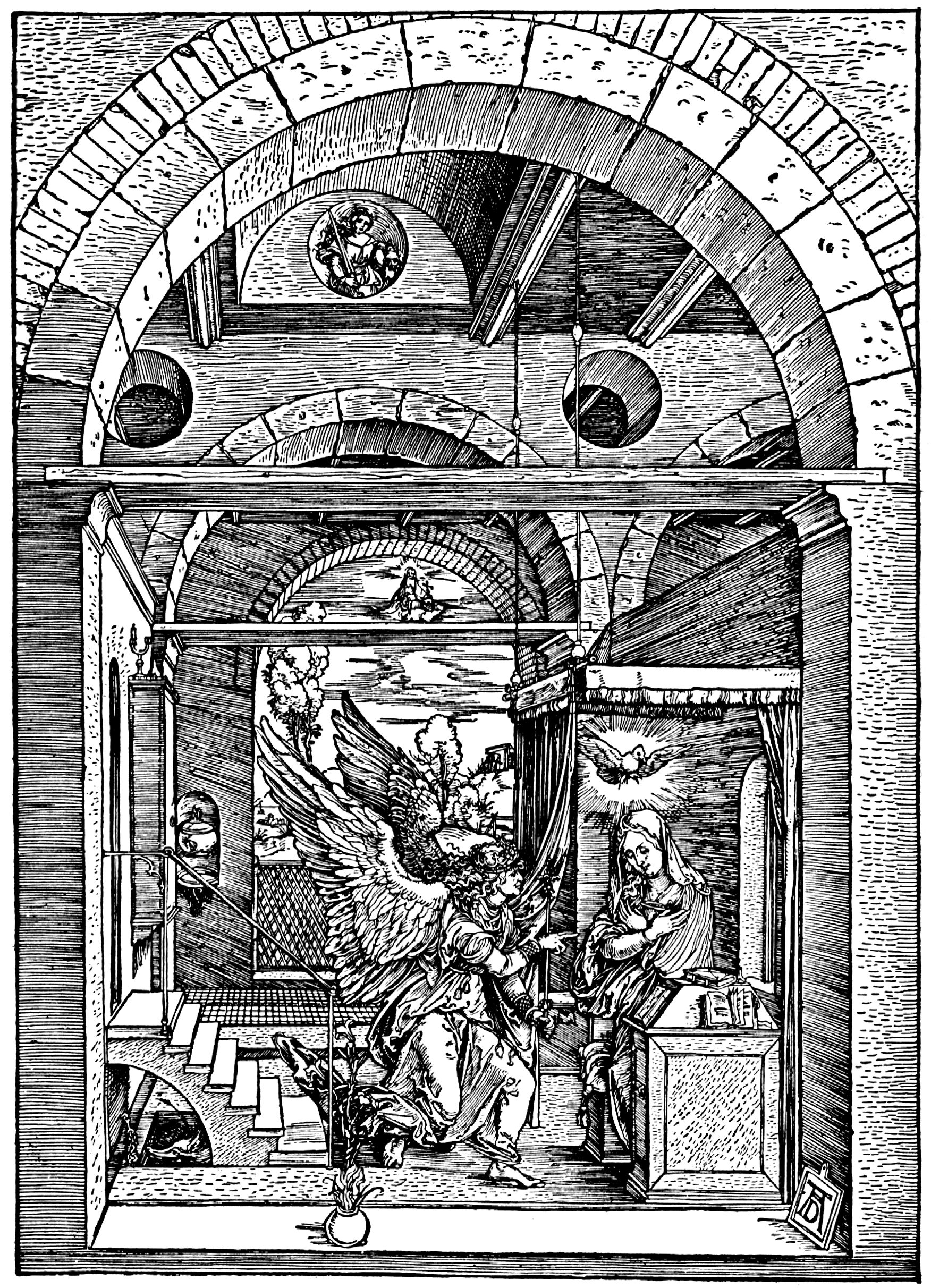
Today is the Feast of the Annunciation. For my part, I will be playing for a service with the (precipitously high-church, Deo gratias) Lutherans over at Emmaus.
Shortly after the account of the Annunciation (Luke 1:26-38) comes the greatest of the Biblical canticles, the Magnificat. For your edification, I offer an excellent recording of Arvo Pärt's setting of this song, as well as two excerpts of a sermon Luther gave on the Magnificat.
(Performed by the Estonian Philharmonic Chamber Choir, dir. Tõnu Kaljuste, found on this CD.)
Luke 1:46-47 (Authorised Version): And Mary said, "My soul doth magnify the Lord, and my spirit hath rejoiced in God my Saviour."
For God is not magnified by us so far as His nature is concerned — He is unchangeable — but He is magnified in our knowledge and experience, when we greatly esteem Him and highly regard Him, especially as to his grace and goodness. Therefore the holy Mother does not say, “My voice or my mouth, my hand or my thoughts, my reason or my will, doth magnify the Lord.” For there be many who praise God with a loud voice, preach about Him with high sounding words, speak much of Him, dispute and write about Him and paint His image; whose thoughts dwell often upon Him, and who reach out after Him and speculate about Him with their reason; there are also many who exalt Him with false devotion and a false will. But Mary says, “My soul doth magnify Him” — that is, my whole life and being, mind and strength, esteem Him highly.
Luke 1:48-49: "For he hath regarded the low estate of his handmaiden: for, behold, from henceforth all generations shall call me blessed. For he that is mighty hath done to me great things; and holy is his name."
The "great things" are nothing less than that she became the Mother of God, in which work so many and such great good things are bestowed upon her as pass man's understanding. For on this there follows all honor, all blessedness, and her unique place in the whole of mankind, among whom she has no equal, namely, that she had a child by the Father in Heaven, and such a child. She herself is unable to find a name for this work, it is too exceedingly great; all she can do is break out in the fervent cry: "They are great things", impossible to describe or define. Hence men have crowded all her glory into a single word, calling her the Mother of God. No one can say anything greater of her or to her, though he had as many tongues as there are leaves on the trees, or grass in the fields, or stars in the sky, or sand by the sea. It needs to be pondered in the heart, what it means to be the Mother of God.
22 March 2011
Detachment
We've all had one of those days, wherein it becomes exceedingly obvious that most people are knaves, louts, and fools. Today the world conspired to give me one of those days. (I shan't bore you with the details.) I am pleased to report, however, that for some reason the parade of asinine behavior did not manage to put me in a bad mood. I suspect that working with children has done me good: if nothing else, it has convinced me that people are not created as bad as they become, and indeed, with a proper education, most can be quite tolerable.
Is this, perhaps, the secret to avoiding irritation (which provokes a host of vices): to simply remove oneself from a situation and observe it as a third party might? It certainly doesn't hurt. I must endeavor to try this in future occasions of unpleasantness.
Angelus Silesius writes,
Is this, perhaps, the secret to avoiding irritation (which provokes a host of vices): to simply remove oneself from a situation and observe it as a third party might? It certainly doesn't hurt. I must endeavor to try this in future occasions of unpleasantness.
Angelus Silesius writes,
Niemand hat seinen Stand so hoch und groß gemacht
Als eine Seel die ihr Gemüth in Ruh gebracht.
13 March 2011
Acedia
Occasionally when I am in a fit of melancholy it leads to acedia, as has happened these past few days. I would describe acedia, but I find that the fourth-century monk Evagrius Ponticus did so far better in his Praktikos:
While we are perhaps not monastics, the affliction is much the same.
The demon of acedia, which is also called the noonday demon, is the most burdensome of all the demons. It besets the monk at about the fourth hour (10 am) of the morning, encircling his soul until about the eighth hour (2 pm). First it makes the sun seem to slow down or stop moving, so that the day appears to be fifty hours long. Then it makes the monk keep looking out of his window and forces him to go bounding out of his cell to examine the sun to see how much longer it is to 3 o’clock, and to look round in all directions in case any of the brethren is there. Then it makes him hate the place and his way of life and his manual work. It makes him think that there is no charity left among the brethren; no one is going to come and visit him. If anyone has upset the monk recently, the demon throws this in too to increase his hatred. It makes him desire other places where he can easily find all that he needs and practice an easier, more convenient craft. After all, pleasing the Lord is not dependent on geography, the demon adds; God is to be worshipped everywhere. It joins to this the remembrance of the monk’s family and his previous way of life, and suggests to him that he still has a long time to live, raising up before his eyes a vision of how burdensome the ascetic life is.
While we are perhaps not monastics, the affliction is much the same.
Subscribe to:
Posts (Atom)